01
Tell us what you need
Start with a short email about your personal tax or business accounting needs.
Toronto · Newmarket · Greater Toronto Area
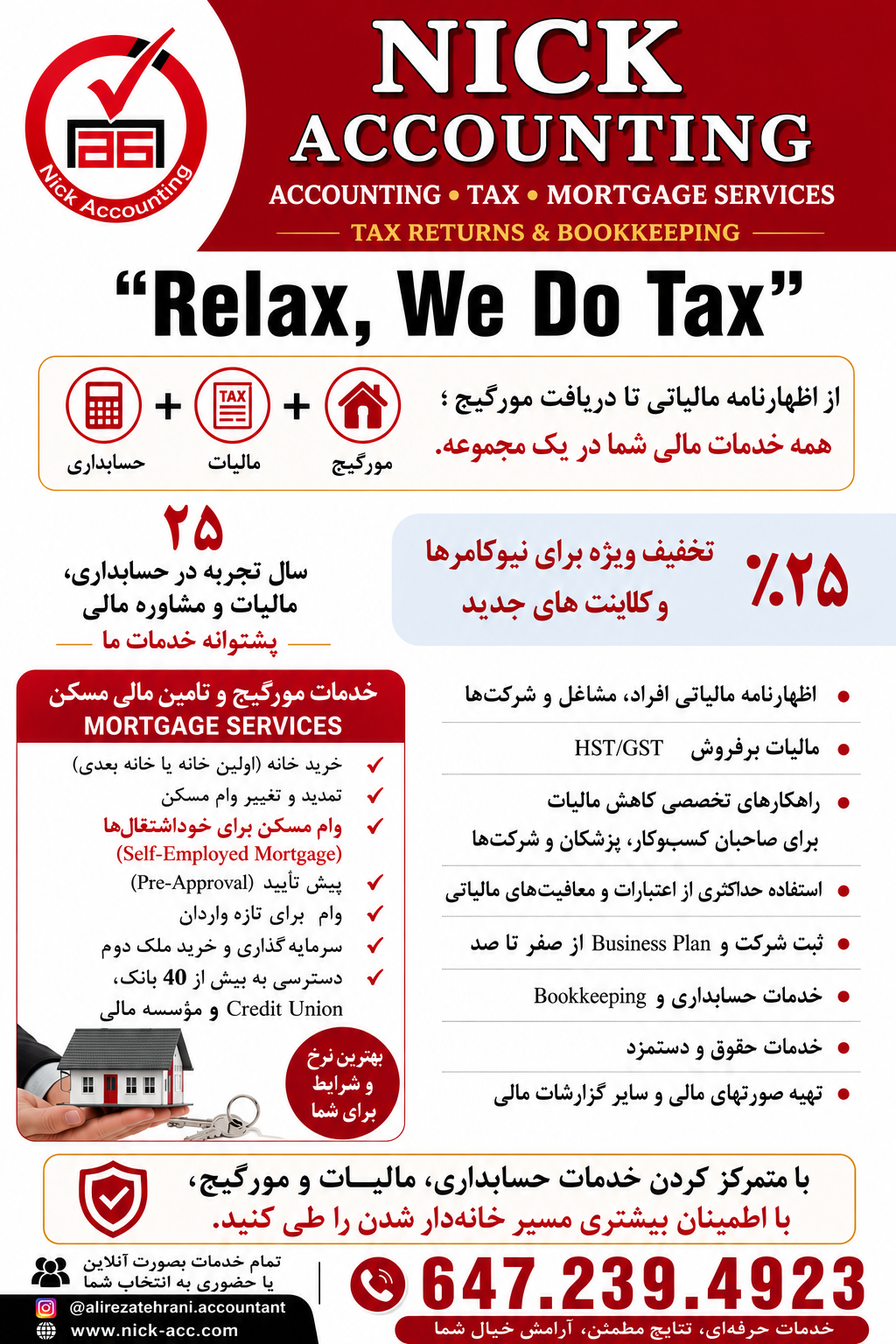
Relax We Do Tax
Personal tax and business accounting, with clear explanations and support in English and Persian.
For individuals, self-employed professionals and small businesses.

Our services
Choose the help you need today. We’ll discuss your situation, the work involved and the fee before we begin.
Tax & accounting insights
Short articles and tax updates for individuals and business owners, with links to official CRA guidance.
Meet your accountant
I’m Alireza Tehrani, founder of Nick Accounting. With a bachelor’s and master’s degree in accounting and more than two decades of accounting and audit experience in Iran, I bring a careful, practical approach to helping clients in Canada.
From your annual tax return to your business books, my focus is on organized records, clear communication and helping you understand what comes next.
Getting started
Start with a short email about your personal tax or business accounting needs.
We’ll discuss the services, fees and records needed for your situation.
Receive help organizing your records, preparing filings and understanding the next steps.
Common questions
Answers to common questions about our accounting and tax services. Select a question to read the answer.
Yes. We assist self-employed professionals, drivers and other small business owners with tax preparation and bookkeeping. Tell us about your activities so we can identify the services you need.
We can review the letter with you, discuss the requested information and help prepare supporting records or a response. Mention any response deadline when you contact us.
Begin with a brief description of your needs and the tax year or business period involved. We’ll let you know which documents are needed after discussing your situation.
Yes. For a self-employed business, eligible actual vehicle expenses are generally allocated using business kilometres divided by total kilometres. Keep receipts and a log showing each business trip’s date, destination, purpose and distance. The employee allowance rates below are not a flat-rate deduction for self-employed individuals.
If you use your personal vehicle in your duties as an employee of your corporation, arrangements may include:
Yes, it can, provided the corporation meets all CCPC requirements. A work permit alone neither establishes nor prevents eligibility. The owner’s Canadian tax residency, rather than citizenship or permanent resident status alone, is relevant; residency depends on the facts, residential ties and applicable treaty rules.
The corporation must be private, resident in Canada and meet the Canadian incorporation or residency requirement. It must satisfy all restrictions on direct, indirect and combined control by non-residents, public corporations and specified listed corporations, and its own shares must not be listed on a designated stock exchange.
Canadian residents holding more than 50% of voting shares does not, by itself, prove CCPC status. Review the share structure, shareholder agreements and actual control before determining eligibility.
Some receipts are generally non-taxable, while others qualify for an exemption only when specific conditions are met. Tax-free does not always mean that nothing must be reported on your return. Common examples include:
Check the rules for the specific payment and tax year before deciding whether to report it or claim an exemption.
2026 update · Reviewed October 5, 2026
Yes, the eligible business-use portion can be deductible. For new passenger-vehicle leases entered into on or after January 1, 2026, the monthly deduction ceiling remains $1,100 before tax. The $1,050 figure in the earlier material is outdated; the ceiling was already $1,100 for new 2025 leases.
This ceiling is not an automatic deduction. The amount depends on actual eligible lease charges, the lease date, business-use percentage and the passenger-vehicle calculation, which may further restrict expensive vehicles. Earlier leases may use the ceiling applicable when the agreement began. Keep the lease agreement, invoices and business mileage records.
Fuel, insurance and maintenance paid separately are generally recorded as separate vehicle expenses and allocated to business use. If insurance or maintenance is included in the lease charges, CRA instructs you to include it in the leasing calculation. Account for sales taxes and any recoverable GST/HST without double-counting.
2026 update · Reviewed October 5, 2026
Different rules apply to active business income and investment income. For an eligible CCPC claiming both federal and Ontario small business deductions, the combined rate on qualifying active business income is 12.2% before July 1, 2026 and 11.2% from that date (9% federal plus 2.2% Ontario). A tax year spanning the change uses a day-weighted rate. Eligibility and the available business limit must be checked.
For an Ontario CCPC, interest and other investment income subject to the ordinary refundable Part I regime generally face an initial combined tax rate of approximately 50.17%: 38⅔% federal plus 11.5% Ontario, before applicable credits and adjustments. This is not one universal rate for every investment receipt; capital gains apply their own taxable-inclusion rules.
Canadian portfolio dividends from non-connected corporations generally face refundable Part IV tax of 38⅓%, rather than the same 50.17% rate. Connected-corporation dividends have different conditions.
Part of the investment tax can be recovered through RDTOH when the corporation pays qualifying taxable dividends, subject to the applicable refund rules. The shareholder may then owe personal dividend tax, so the initial corporate tax is not necessarily a permanent loss of half the income.
Passive income can also reduce access to the federal small business deduction: the associated group’s adjusted aggregate investment income above $50,000 reduces the federal business limit, with the standard $500,000 limit fully eliminated at $150,000. The relevant prior-year income and Ontario’s separate rules must be reviewed.
Ontario: corporate income tax rates
CRA: federal and provincial corporation rates
Client feedback
Let’s talk
Tell us a little about what you need. We’ll follow up to discuss how we can help.
nickacc2023@gmail.comServing East Gwillimbury, Newmarket and the Greater Toronto Area.